
Passive Income Ideas That Work While You Sleep
What passive income ideas actually work while you sleep? The ones that hold up are usually cash-based, like high-yield savings accounts and Treasury bills, or asset-based, like dividend funds, digital products, and rental-style investments. They do take setup. After that, though, the upkeep can be light enough to feel genuinely passive.
Key takeaways
- The most reliable passive income usually comes from cash, funds, or assets that need limited upkeep after setup.
- Ideas that sound passive can turn into part-time jobs if they depend on traffic, posting, or constant updates.
- If you have cash, simple investments usually beat content-based ideas for ease and predictability.
- If you have time and a marketable asset, digital products can scale better than savings interest.
- Choose based on maintenance, liquidity, and risk, not on how passive the idea sounds.
What passive income ideas really are, and what they are not
Passive income is money that keeps coming in after the heavy lifting is done, but it is rarely zero-work money. For a U.S. reader, that usually means putting cash into an account or asset, or creating something once and letting it sell without daily labor. The real question isn’t whether the idea sounds passive; it’s how much work it needs after launch.
There are three useful buckets. Capital-based income comes from putting money to work, like Treasury bills through TreasuryDirect, a high-yield savings account, or a brokerage fund at Fidelity or Vanguard. Content-based income comes from making an asset once and selling it again and again, like an e-book through Amazon KDP or a design file on Etsy. Asset-based income comes from owning something that generates returns, such as a rental-style real estate investment through a platform like Fundrise.
The trap is online ideas that look passive but act like part-time jobs. Affiliate marketing, YouTube channels, and many AI-assisted content businesses can turn into income streams, but they usually need traffic, publishing, updates, and audience management. Even with tools like OpenAI helping with drafting or research, you still have to pick topics, edit, distribute, and keep the asset going.
That’s why the trade-off matters more than the label. If you have cash, low-maintenance income is usually easier to start than content creation. If you have time and an audience, digital products can scale better than savings interest. If you have neither, the idea may be passive on paper and frustrating in practice.
The best passive income ideas by startup cost and effort
The cleanest way to compare passive income ideas is by startup cost, time to first dollar, maintenance, and effort. That makes the trade-offs obvious fast, especially for U.S. readers choosing between parking cash, investing, and building digital assets.
| Idea | Startup cost | Time to first dollar | Ongoing maintenance | Effort level | Best fit | Main trade-off |
|---|---|---|---|---|---|---|
| High-yield savings account | Low to moderate | Fast | Very low | Low | Beginners and emergency-fund holders | Simple and stable, but income is limited by the balance |
| Treasury bills via TreasuryDirect | Low to moderate | Fast | Very low | Low | Savers who want a government-backed option | Low upkeep, but you must wait for maturity and accept rate changes |
| Dividend stocks through Fidelity or Vanguard | Moderate | Depends on settlement and dividend schedule | Low to moderate | Low to moderate | Investors with a long time horizon | More growth potential than cash, but market value can move |
| Digital products on Etsy or Amazon KDP | Very low to low | Slow to moderate | Moderate | Moderate | Creators and organizers | Low startup cash, but sales usually require some marketing |
| Affiliate marketing | Very low | Slow | High | High | People with an audience or SEO skill | Looks passive, but traffic and conversion work never really stop |
| Rental-style real estate investing, including Fundrise | Moderate to high | Slow | Low to moderate | Moderate | Investors who want real estate exposure without direct landlord work | Less hands-on than owning a house, but still tied to market and platform risk |
High-yield savings accounts are the simplest on-ramp because the cash is already liquid and the account needs almost no management. Treasury bills are just as low-maintenance once bought through TreasuryDirect, which makes them appealing for people who want a defined maturity date instead of constant trading. Both work well for readers who value certainty and speed over upside.
Dividend stocks and broad index exposure through a brokerage account at Vanguard or Fidelity are more hands-off than building income from scratch, but they’re not the same as parking cash. You’re taking market risk in exchange for the chance of long-term growth and distributions. That makes these a better fit for investors than for people who want near-term spending money.
Digital products are the most misunderstood category. A printable, template, or short e-book can be created once and sold many times, but the storefront still needs keywords, thumbnails, pricing checks, and customer support. On Etsy and Amazon KDP, the asset can work for you, but it usually needs periodic attention to keep moving.
Affiliate marketing sits at the far end of the semi-passive spectrum. It can become durable once content ranks or a newsletter gains traction, but it’s usually a traffic business first and an income stream second. If your goal is low maintenance, this is the category most likely to disappoint.
Passive income ideas that can work with very little maintenance
The lowest-friction passive income ideas are the ones that mainly require one opening decision, not ongoing hustle. Cash tools and broad investing do that best, while simple digital assets can work if you’re willing to trade more setup time for more upside later.
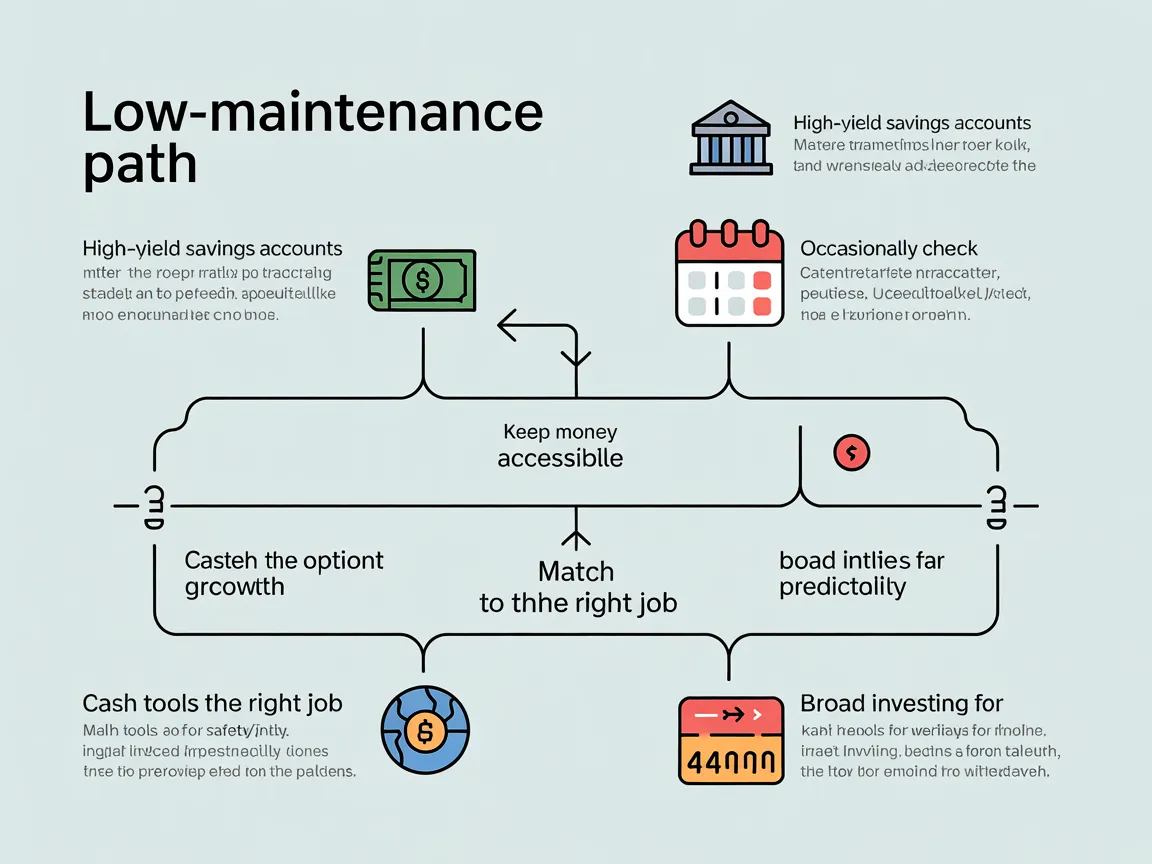
- High-yield savings accounts are the easiest place to start because they keep your money accessible and usually need only an initial transfer and occasional rate checks. The maintenance is tiny, but the income ceiling is also tiny unless the balance is large.
- Treasury bills are a strong next step for savers who can leave money untouched until maturity. The draw is predictability, but the money is tied up for a set period, so they are not ideal for funds you may need next week.
- Broad index fund exposure through a brokerage account is more hands-off than trying to stock-pick for income. A diversified fund at Fidelity or Vanguard can keep working with minimal intervention, though you still need to watch allocation, taxes, and market swings.
- Dividend-focused funds can be simpler than owning a basket of individual dividend stocks because the fund handles diversification. The catch is that dividends fluctuate, and a high payout alone is never a reason to buy.
- Simple digital assets such as templates, checklists, printables, and stock media can be made once and sold repeatedly. These can feel passive after the first build, but they usually need occasional refreshes, better listing photos, or new keywords to stay visible.
- Rental-style investments through platforms like Fundrise reduce the landlord burden compared with direct property ownership. That makes them appealing for investors who want real estate exposure without fixing toilets, though platform fees and asset performance still deserve attention.
The smartest use of these ideas is matching them to the right job. Cash tools are for safety and liquidity. Broad funds are for long-term compounding. Digital products are for people who can create something useful once and keep polishing the listing instead of chasing daily sales calls.
How to choose the right idea without wasting months on the wrong one
The best choice depends on what resource you already have: cash, time, or audience reach. If you choose the wrong resource match, you can spend months learning a model that was never built for your situation.
- Start with your strongest resource. If you have spare cash, look first at Treasury bills, high-yield savings accounts, dividend funds, or Fundrise-style real estate exposure. If you have time and design or writing skill, digital products may make more sense. If you already have an audience, content-based income becomes more realistic than starting from zero.
- Check time-to-first-dollar separately from maintenance. A low-maintenance idea can still pay slowly. Treasury bills and savings accounts can generate income quickly once funded, while an Etsy listing or Amazon KDP book may take time to get its first sale.
- Ask whether the income stays passive after setup. If the model depends on weekly posts, aggressive sales outreach, or customer service chats, it is semi-passive at best. That does not make it bad, but it should not be mistaken for sleep-friendly income.
- Reject ideas that need nonstop promotion if your real goal is simplicity. Affiliate marketing and some content businesses can work, but they usually behave more like businesses than assets. Beginners often burn out by picking the highest-upside path instead of the one they can actually maintain.
- Choose one lane for 90 days. Splitting attention across savings products, digital downloads, and a YouTube channel usually slows everything down. A focused test gives you cleaner feedback on whether the income stream fits your budget and attention span.
The biggest beginner mistake is confusing delayed payoff with passive payoff. A model that takes six months to produce income is not automatically passive, and a model that pays quickly is not automatically easy. Look at the maintenance burden first, then the first-dollar timeline.
A side-by-side passive income decision framework
A useful ranking system should judge passive income ideas the way a buyer would judge a car: by cost, upkeep, convenience, and long-term usefulness. The Passive Income Fit Score below does that with four criteria that matter to real readers, not just marketers.
- Upfront Cash Required: How much money you need to start, from low cash outlay to high capital commitment.
- Setup Effort: How much work it takes to create or buy the income stream before it can earn.
- Ongoing Maintenance: How much attention it needs after launch, including updates, monitoring, and customer support.
- Scalability: How well the income stream can grow without matching growth in your personal time.
| Category | Upfront cash required | Setup effort | Ongoing maintenance | Scalability | Who it favors |
|---|---|---|---|---|---|
| High-yield savings accounts | Low | Very low | Very low | Low | Beginners and savers |
| Treasury bills | Low to moderate | Low | Very low | Low | Savers who want defined terms |
| Dividend and index funds | Moderate | Low to moderate | Low to moderate | Moderate | Long-term investors |
| Digital products | Very low to low | Moderate | Moderate | High | Creators and organizers |
| Affiliate marketing | Very low | High | High | High if traffic grows | Audience builders and SEO-heavy publishers |
| Rental-style real estate investing | Moderate to high | Moderate | Low to moderate | Moderate | Capitalized investors |
This framework gives a practical answer for different profiles. Beginners usually do best with high-yield savings accounts or Treasury bills because the setup is simple and the maintenance is minimal. Savers with a larger balance can move toward dividend or index funds. Creators tend to fit digital products better because the upside scales with the quality of the asset, not the number of hours worked that week.
The wrong fit is usually obvious once you score the categories honestly. If an idea scores high on scalability but also high on maintenance, it may be a business, not passive income. If it scores low on cash but high on setup and maintenance, it may look cheap but still cost too much time. That’s why a framework beats a generic list.
For readers who want a concrete starting point, the order is simple: cash first if you need safety, funds next if you want hands-off investing, digital products if you can build once and sell many times. The more an idea depends on constant sales or content output, the less it belongs in a true passive income plan.
What to do next if you want income that works while you sleep
The most realistic passive income plan starts with one low-maintenance stream and one test project, not five ideas at once. That keeps the portfolio stable while giving you room to build something with more upside later.
- Choose one cash-based option, such as a high-yield savings account or Treasury bills, if your priority is low effort and predictability.
- Open a brokerage account at Fidelity or Vanguard if your next step is long-term investing rather than immediate spending money.
- Pick one digital asset idea, such as a printable or template, only if you can commit to listing, pricing, and occasional updates.
- Treat YouTube, affiliate marketing, and similar models as semi-passive businesses, not sleep-and-forget assets.
- Review fees, taxes, liquidity, and maintenance before moving money or building a product.
- Use the Passive Income Fit Score to rank every idea you consider before you start.
Frequently asked questions
What are the easiest passive income ideas to start with?
High-yield savings accounts and Treasury bills are usually the easiest starting points because they need little ongoing management. If you want more upside and can handle more risk, broad index funds are a common next step.
Can passive income ideas make money with no upfront investment?
Sometimes, but usually only if you count your time as the investment. Most of the stronger options need either cash, an existing audience, or a product you create and market.
What is the safest passive income idea?
For most people, a high-yield savings account or Treasury bill is among the safest choices because the goal is preservation, not growth. The trade-off is lower return potential.
How long does it take for passive income to start paying?
It depends on the model. Cash-based options can start quickly, while digital products, affiliate sites, and rental-style assets may take weeks, months, or longer before they produce meaningful income.
Is rental income really passive?
Not fully. Even when a property manager handles day-to-day work, owners still deal with financing, taxes, repairs, vacancies, and oversight.