
Amazon Vine Program: how to participate and test products
Amazon Vine is an invitation-only product testing program.
Selected U.S. customers receive products for free, test them, and publish honest reviews. There’s no public application.
The practical path is to build a useful, policy-compliant review history, look out for an Amazon invitation, and consider the potential tax cost before ordering anything.
Amazon Vine Program
Key takeaways
- Amazon does not publish a public application, so your only real path is to earn an invite through a strong review history.
- Invitations, when they happen, show up in your Amazon account, so check your Message Center and Vine-related pages regularly.
- Vine items can carry tax consequences in the United States, so confirm the current IRS treatment before you claim any product.
- You should review only products you actually tested, and the review needs to stay focused on the item, not the seller or shipping drama.
What Amazon Vine is, and who it is for
Amazon Vine connects selected reviewers with products that participating brands submit to Amazon.
According to Amazon Customer Service, Amazon invites customers who have built trust through accurate, insightful reviews.
Those customers can then receive free copies of products enrolled in the program.
Amazon calls invited reviewers Vine Voices.
Brands provide the inventory, but their control ends there.
They don’t select reviewers, approve review language, or require positive ratings.
Amazon also says it neither influences nor edits the opinions submitted by Vine members.
Why the program exists
The economics are simple. A new product may have little buyer feedback, making its quality difficult to assess.
Sellers place units in Vine, Amazon offers them to independent Voices, and their reviews help future shoppers make better-informed decisions. Sellers risk critical feedback.
Reviewers take on the testing time, program obligations, and potential tax consequences associated with each item.
The public Amazon Vine shopper page explains the program but does not publish a count of active U.S.
Vine Voices or an annual market valuation. Treat specific estimates cautiously unless Amazon supports them with a dated release.
This guide focuses on the U.S. shopper experience. It explains how invitations work, where to check for access, how to select items, and what’s required when reviewing them.
What actually gets you invited to Amazon Vine
A solid review history can strengthen the profile Amazon evaluates. Still, Amazon alone decides whether an invitation arrives and when it appears. The following control-and-evidence checklist helps separate actions you can take from claims that amount to speculation.
| What you can control, such as the quality, consistency, and usefulness of your Amazon review history. | What Amazon controls, including who receives an Amazon Vine invitation and when access appears. |
|---|---|
| Write specific reviews based on products you genuinely used. Explain fit, setup, limitations, and the type of buyer the item suits. | Amazon selects Vine Voices. A seller, brand, paid service, or customer-service representative cannot issue a legitimate invitation. |
| Review consistently when you have something useful to add. Quality should take priority over posting volume. | Amazon does not publish a guaranteed review count, helpful-vote target, spending requirement, or invitation schedule. |
| Follow Amazon review policies and keep the review about the product rather than packaging delays or a dispute with the seller. | Amazon may change selection signals, account access, participation levels, and program requirements. |
| What tends to help, such as detailed, helpful reviews that show you write for real shoppers rather than for sellers. | What can disqualify or weaken a profile, including low-quality review patterns, policy issues, or account behavior that does not look trustworthy. |
|---|---|
| A review that answers likely buying questions is more useful than a long description of features already listed on the product page. | Copied wording, promotional language, irrelevant seller complaints, or reviews that conflict with Amazon Community Guidelines can undermine trust. |
| Photos or video can clarify scale, assembly, controls, texture, or defects, but they help only when they add evidence. | A sudden stream of shallow reviews can look less credible than a smaller history of product-specific evaluations. |
| Writing from a shopper’s perspective helps. State what you tested and distinguish an observed limitation from a personal preference. | Accepting payment or free items directly from a seller in exchange for a review violates the official program boundary. |
| Where to verify your status, including your Amazon account and any Vine-related pages or messages Amazon provides. | How strong the evidence is, separating official rules from practical guidance and informed interpretation. |
|---|---|
| Sign in to the correct Amazon account and inspect Account, Message Center, your public profile, and any Vine page Amazon makes available. | Official: Amazon says invitations reflect trust earned through accurate and insightful reviews. Amazon Vine |
| Check the account that contains your strongest established review history, especially if you maintain more than one Amazon login. | Practical guidance: vine-wiki.com discusses standing in the reviewer community and missed invitations, but it is not Amazon. |
| Treat an invitation as genuine only when it resolves inside your signed-in Amazon account or an official Amazon page. | Interpretive: WikiHow suggests tactics such as regular reviews and useful media. These are suggestions, not eligibility rules. |
Control is the important distinction here.
As practical guidance, you can improve existing reviews by making them clearer and more useful to shoppers.
Amazon does not confirm that purchasing more products, pursuing helpful votes, or changing review frequency increases invitation odds. Never pay someone who claims to have an application link or guaranteed access.
How Vine invitations work and where to check your status
Vine invitations come directly from Amazon.
There’s no public application form that shoppers can use to join. If an invitation has expired, sign in to the account that received it and visit Amazon’s Vine portal; if access is unavailable, contact Amazon Customer Service, since restoration is not guaranteed.
For multiple accounts, use the account Amazon invited.
Suggestions about choosing an account based on reviewer rank are secondary practical advice, not a confirmed Amazon selection signal.
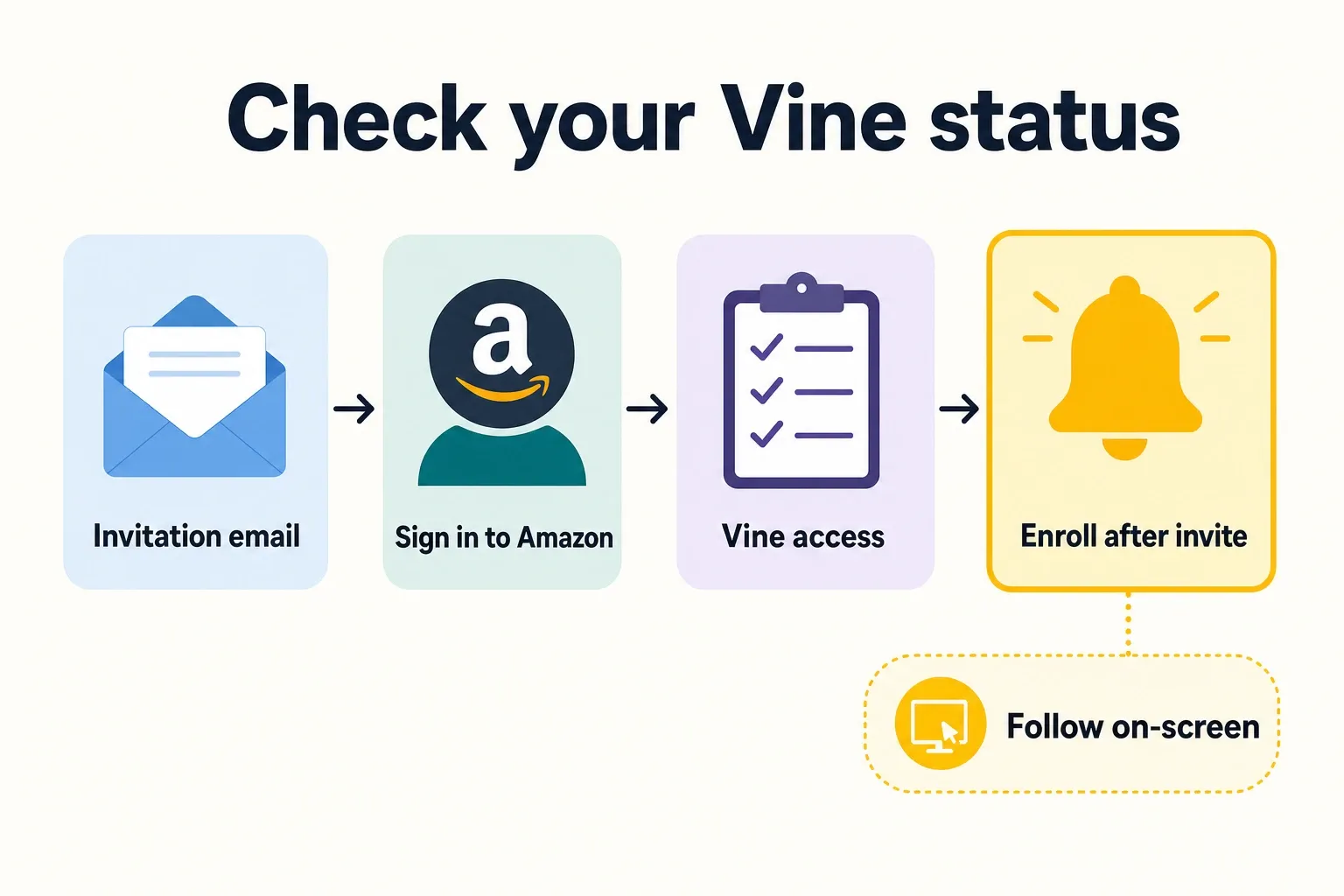
- Confirm the invitation inside Amazon.
- Read and accept the Participation Agreement.
- Complete the Tax Questionnaire if Amazon prompts you.
- Confirm activation.
- If the email is missing, open Your Account and check Message Center, then inspect any Vine page available through your account.
- Use Amazon Customer Service for an account-specific access problem, but do not ask a seller to nominate you.
Amazon can change menu labels and enrollment prompts. Always follow the instructions displayed inside your signed-in U.S. account rather than relying on vine-wiki.com, WikiHow, blog posts, or screenshots taken from another member’s account.
How to submit Vine reviews the right way
A proper Vine review should follow meaningful use of the product and present an honest opinion that complies with Amazon’s review policies. Praise isn’t required. Critical findings are acceptable as long as they describe the product accurately and follow the Amazon Community Guidelines.
- Use the product in a realistic setting.
- Open the review task from the Vine area associated with the item, or use Amazon’s available review control for the order.
- Lead with the purchasing consequence.
- Separate observation from preference.
- Include useful media when it proves a point.
- Submit after enough testing to support the claims.
- Review any rejection notice and edit only the noncompliant portion.
According to the Amazon Community Guidelines, Amazon marks the contribution as a “Vine Customer Review of a Free Product.” That label gives shoppers useful context: the reviewer didn’t make a standard retail purchase, although the brand still has no authority over the rating.
The guidelines also bar reviewers from using their Vine status to seek compensation or extra products directly from brands. An offer made outside official Vine listings creates a policy risk. Don’t mistake it for a legitimate free product offered through Amazon’s testing program.
What products Vine Voices can test, and the common limits
A Vine item may come from a major Amazon category, but Voices don’t receive access to an unlimited catalog.
Each person sees a selection that changes over time, and Amazon may change ordering limits or participation conditions.
Use the limits displayed in your own Vine account rather than relying on unsupported descriptions of membership levels.
- Electronics: accessories, small devices, computer peripherals, and similar products may appear. Check compatibility before requesting an item because receiving it does not make it useful for your setup.
- Home goods: kitchen tools, storage products, bedding, lighting, and household accessories are common examples in secondary program guidance.
- Books: a book requires enough reading time to evaluate the actual work. A summary based on the description is not a product-use review.
- Health and beauty: review only what you can evaluate responsibly. Avoid diagnoses, treatment promises, or medical advice that your product experience cannot support.
- Sports and outdoors: verify size, intended activity, installation requirements, and safety instructions before ordering.
- Limited availability: popular listings can disappear as other Vine Voices claim units. Speed matters only after checking suitability, fair market value, and whether you have time to test the product properly.
- Account-level access: Amazon may use level or standing requirements that affect selection and request limits. Check the current Vine dashboard for the rules attached to your account instead of relying on an old tier chart.
The cost hidden inside “free”
A Vine item may carry a taxable value, so paying nothing at checkout doesn’t always mean the product has no financial consequences.
Before requesting it, review the value shown in Vine and open Resources, then Vine Tax FAQ, through the signed-in Amazon Vine member portal. Amazon’s tax forms are also available through Amazon Tax Central.
For federal information-return rules, use the IRS page for Form 1099-NEC, not a company blog. The threshold that requires a payer to issue a form is a reporting threshold, not a rule declaring amounts below it tax-free.
A federal information-return threshold is not a measure of Vine’s market size or a tax-free allowance. Income may still be taxable even when no form is issued, as explained in the IRS guidance on taxable and nontaxable income.
Review each item’s listed value before ordering, keep your Vine tax records, and use the current Tax Questionnaire and tax documents in your account when preparing your return.
A common beginner mistake is viewing every available item as a risk-free reward. An unnecessary product can use up review capacity, carry a reportable value, and become one more object that’s hard to store or test thoroughly.
Frequently asked questions
Can you apply directly for Amazon Vine?
What if you have multiple Amazon accounts?
Do Vine members pay taxes on free products?
Can sellers or brands contact you outside Vine for free products?
How we researched this
Sources consulted for this article:
⚠️ Disclaimer:
This website is for informational purposes only and is not affiliated with, endorsed by, or responsible for any product testing program mentioned. All applications, selections, product shipments, and testing processes are managed exclusively by the respective companies. Please refer to each company's official website for the most current information.
AMAZON FREE ITEMS
Official tester program – free products forever
View a short ad to unlock