
Best Free Hobby Ideas for Adults at Home
What are the best free hobby ideas for adults at home? The strongest options are reading, journaling, sketching, bodyweight exercise, and simple cooking or organizing projects, since you can start with what’s already in the house and test them before spending real money. This guide also shows where to borrow, learn, and practice for free in the U.S., so a new hobby stays fun instead of turning into a bill.
Key takeaways
- 5 easy hobbies can start with items already at home, so you can test them today without buying gear.
- If you only have 15 to 20 minutes, choose reading, journaling, or stretching, not hobbies that need setup.
- Use a 2-week trial and a small budget cap before buying supplies, so a new interest does not turn into a spending trap.
- A library card can unlock free books, audiobooks, and streaming options through participating U.S. library systems.
- Choose the hobby that matches your energy level first, then your space, so you are more likely to keep it up.
Hobbies That Need Almost Nothing to Start
- Reading with books you already own, library books, or a phone reading app
- Journaling and creative writing with a notebook, loose paper, or a notes app
- Sketching, coloring, and simple doodling with printer paper and a pencil
- Bodyweight fitness, stretching, and mobility work with no gear beyond comfortable clothes
- Cooking practice, home organization, and decluttering as hobbies that use what is already in the house
Reading is the easiest no-cost hobby to start, because a paperback on your shelf, a borrowed library book, or a free digital checkout from a public library can fill an evening with no setup at all.
If you want more variety, the Library of Congress can help with historical newspapers, photographs, and audio recordings, while Hoopla and Kanopy are useful through participating libraries for ebooks, audiobooks, and streaming films. The payoff is straightforward: you can see whether long-form focus feels good before you buy a single new title.
Journaling and creative writing work well if you want something private, flexible, and cheap. A grocery list notebook is enough, and a notes app on your phone works fine if you write more when the device is already in your hand. The usual mistake is waiting for the perfect notebook or prompt system, which turns a free habit into a shopping project.
Sketching, coloring, and doodling are the same kind of low-friction hobby, just on the visual side. Printer paper and a pencil are enough for blind contour sketches, page borders, or copying the shape of a mug on your table. A lot of adults quit because they think talent has to come first, but the real starter move is ten minutes of line practice, not a full art supply haul.
Bodyweight fitness, stretching, and mobility work belong here because they need space more than equipment. Comfortable clothes and a clear patch of floor are enough for squats, wall pushups, calf raises, or a 10-minute stretch routine after work. The trade-off is simple, this hobby gives you structure and movement, but it doesn’t need a treadmill, resistance bands, or a monthly gym fee to begin.
Cooking practice, home organization, and decluttering can count as hobbies when you approach them intentionally instead of treating them like chores. A batch of pantry rice, a half-empty spice rack, or one overstuffed drawer can become a small project with a clear before-and-after. It’s a strong fit for adults who like visible results, because the payoff shows up in a cleaner shelf, a better meal, or a pantry that makes weeknight cooking easier.
How to Choose a Hobby Based on Time, Space, and Energy
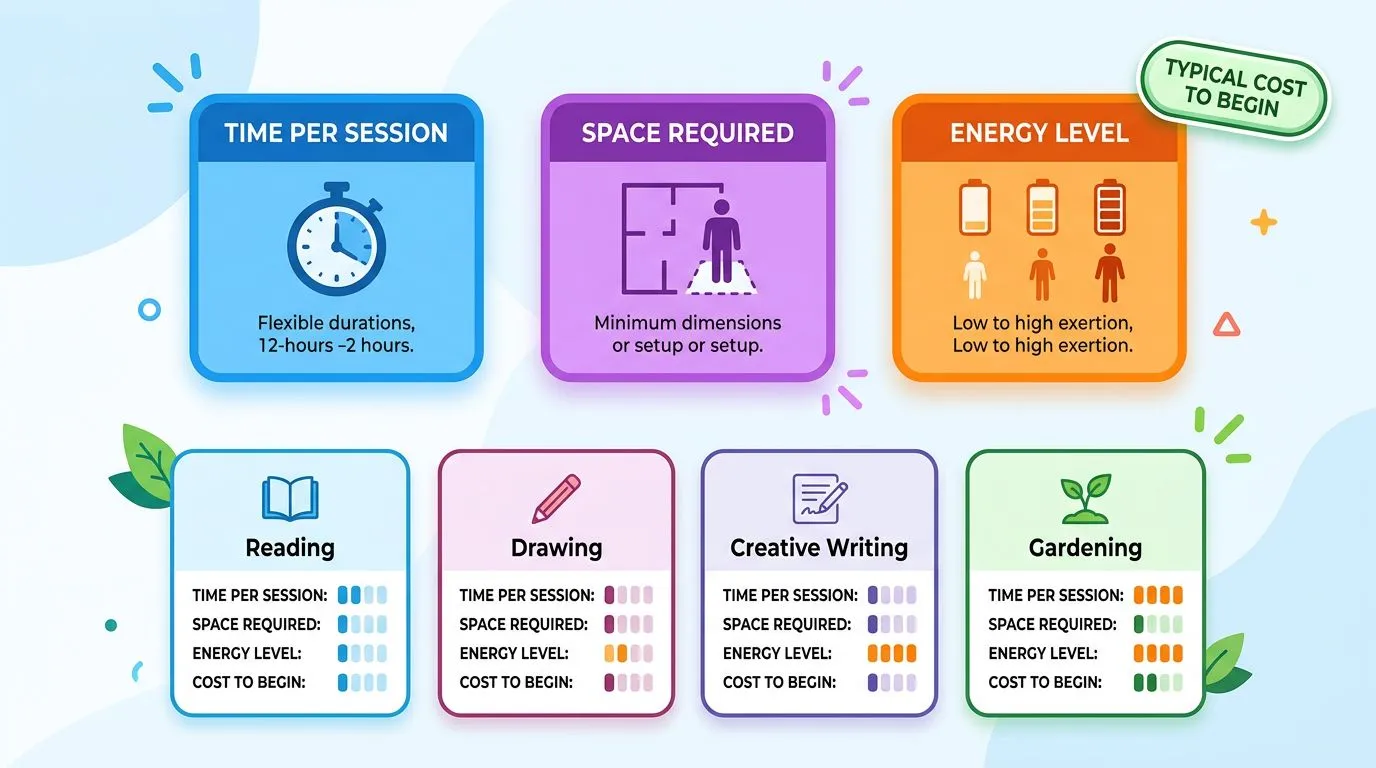
| Time per session | Space required | Energy level | Typical cost to begin |
|---|---|---|---|
| Reading | 20 minutes to several hours | Couch, bed, or chair | Low, often $0 if you use library books or digital lending |
| Journaling or writing | 10 to 45 minutes | Desk, table, or lap | Very low, usually $0 to a few dollars for paper or an app |
| Sketching or coloring | 15 to 60 minutes | Desk or table | Very low, often under $5 if you already have a pencil and paper |
| Bodyweight exercise or stretching | 10 to 30 minutes | Open floor space | $0 to start |
| Cooking practice or decluttering | 30 minutes to a few hours | Kitchen or any room being sorted | $0 if you work with what you already own |
The right hobby is usually the one that fits your real schedule, not your ideal one. If you only have 15 minutes after dinner, reading, journaling, and stretching are easier to keep than a hobby that needs setup, cleanup, or a dedicated room. The beginner mistake is picking something that sounds impressive but only works when the house is quiet, the dog is asleep, and you feel fully refreshed.
Space matters more than people expect. A couch hobby like reading will survive a small apartment, while bodyweight work needs a cleared floor and enough room to move your arms without hitting furniture. If you live with others, choose something that can pause and resume quickly, because interruptions are what kill momentum.
Energy level is the third filter, and it should be honest. After a draining workday, a restful hobby such as reading or sketching is more realistic than vigorous exercise, while a weekend morning may be the right time for stretching, pantry organizing, or a longer cooking project. Matching the hobby to your energy is what keeps it from becoming another obligation.
Low-Cost Ways to Test an Interest Before Buying Gear
- Use library books, digital lending apps, and free online tutorials to learn the basics
- Borrow or share starter gear instead of buying a full setup
- Set a short trial period and a small budget cap before making any purchase
- Decide whether the hobby is worth keeping after a few practice sessions
Use free learning first, because that’s the cheapest way to find out whether the hobby feels good in real life. Public libraries often give you access to print books, ebooks, audiobooks, and classes, and many also point patrons to digital collections like Hoopla and Kanopy through their own accounts. YouTube can help with technique, while Coursera and edX are useful if you want a more structured lesson before you spend any money.
Borrowing gear is the second filter, and it’s where a lot of smart hobby testing happens. Freecycle can help you find people giving away usable starter items, and a local friend, neighbor, or family member may already have the thing you need for one weekend of practice. The point isn’t to build a perfect setup right away, it’s to find out whether the activity itself holds your attention long enough to justify ownership.
Set a short trial period and a strict cap before you buy anything. For example, give yourself a few practice sessions or, as a rule of thumb, about two weeks of trying the hobby, then decide whether the interest survived the novelty phase. That pause keeps you from treating the first excited moment like a permanent commitment.
After the trial, judge the hobby on use, not fantasy. If you reached for it several times without forcing yourself, and you can name one specific reason you want to keep going, the hobby probably deserves a small purchase. If the gear is the only reason you still care, stop there and move on.
Where to Find Free or Low-Cost Hobby Resources
- Public libraries for books, digital lending, workshops, and sometimes passes or kits
- Makerspaces and community centers for shared tools, classes, and open-use rooms
- Buy Nothing groups and local swap groups for borrowing, trading, or picking up starter gear
- Parks, recreation departments, and walking trails for low-cost fitness, nature hobbies, and outdoor practice
- Local colleges, museums, and volunteer groups for occasional free talks, demos, or beginner-friendly events
Public libraries are the best starting point because they often give you more than books. Many branches host workshops, book clubs, seed libraries, craft nights, and device help, and some lend museum passes or hobby kits depending on the branch. If you want to sample several interests without paying retail, the library is the first place to check.
Community centers and local Parks and Recreation departments are useful when your hobby needs a room, a table, or a place to move. An open gym, a rec-center class, or a walking trail can turn a solitary idea into a regular routine without requiring you to own the space yourself. Meetup can also help you find low-pressure beginner groups in your area, which is useful when you want accountability without a membership fee.
For supplies, Freecycle is worth a look before you buy anything new. It works best for simple items like bookshelves, yoga mats, art materials, or kitchen tools someone doesn’t want anymore but can still use. The practical upside is pretty clear, one free pickup can cover the exact item you need for a trial run.
Museums, colleges, and volunteer groups fill out the free learning options. Smithsonian resources such as the Smithsonian Learning Lab can be especially handy if your hobby overlaps with history, art, science, or collecting, since the material is broad and easy to browse from home. If you like a bit of structure, a free talk or demo gives you a feel for the hobby’s culture before you spend on tools or classes.
How to Keep a New Hobby From Turning Into a Spending Trap
- Delay gear upgrades until the hobby is consistent
- Buy used, borrow, or trade before purchasing new items
- Avoid subscription creep, course bundles, and impulse add-ons
- Track hobby spending separately so the budget stays visible
Hold off on upgrades until the hobby has shown up on your calendar more than once. A secondhand chair, a better sketchbook, or nicer cookware can make sense later, but early upgrades are usually where budgets leak. If you still haven’t used the hobby regularly, that upgrade is probably decoration, not a need.
Buy used, borrow, or trade first, because the hobby itself matters more than the packaging. For a lot of at-home interests, the gap between starter gear and premium gear is smaller than ads make it sound, especially in the first month. That’s why the smartest spend is often the one you put off.
Keep an eye on subscription creep and bundle traps. A free hobby can get expensive fast when a basic interest turns into paid courses, recurring apps, specialty supplies, or one-click add-ons that look tiny on their own. The simplest fix is to track hobby spending in a separate note or budget line so every new purchase is visible before you hit confirm.
The best free hobby ideas for adults at home are the ones you can start today, test cheaply, and keep only if they earn a place in your routine. Reading and writing fit small schedules, sketching and stretching fit tiny spaces, and cooking or organizing reward people who like visible results. The next calls are practical ones: pick a hobby that matches your time, figure out how much space it needs, and set a hard spending limit before you buy the first piece of gear.
Frequently asked questions
How long should I try a hobby before deciding if it is for me?
A few sessions is usually enough to tell whether the hobby fits your attention span and routine. In the article’s example, a short trial of a few practice sessions or about two weeks is enough to get past the novelty phase. If you still have to force yourself to do it after that, move on without guilt.
What if I do not have a lot of space at home?
Pick hobbies that pack away fast or work in a small footprint, like reading, journaling, sketching, or language learning. If the hobby needs floor space, bodyweight exercise and stretching can still work with a clear patch of floor and comfortable clothes. For anything with supplies, a good rule is whether you can clear it away in under a minute.
Can a hobby still be free if I use an app or online class?
Yes, as long as the free tier covers what you actually need. Public libraries, Hoopla, Kanopy, YouTube, Coursera, and edX can all support a hobby without upfront cost, but the trap is upgrading too early. Avoid automatic renewals, paid add-ons, and bundles until you know the hobby is sticking.
What is the cheapest way to get starter supplies?
Borrow first, then buy used if the hobby survives your trial. The article points readers to public libraries, Freecycle, Buy Nothing groups, and local swap networks, which are often the fastest ways to get books, yoga mats, art materials, or kitchen tools without paying full price.