
50 Did You Know Facts That Sound Fake But Are 100% True
What makes a fact sound fake but still true is a mismatch between expectation and evidence: it sounds impossible at first, but a real record, law, species, measurement, or official source backs it up. This guide gives you verified weird facts plus a credibility filter, so you can tell the difference between surprising and sloppy.
Key takeaways
- True weird facts usually hinge on specific records, measurements, or biology, not vague internet claims.
- The most shareable trivia sounds impossible because it clashes with everyday intuition.
- A quick credibility check can save you from repeating a fake-looking fact.
- Some of the best examples are memorable because they pair a simple claim with a hard-to-fake source.
- Use surprising facts carefully: they work best when the wording stays precise.
What makes a fact sound fake but still be true?
A fact sounds fake when it clashes with what people assume is normal, which is why specifics matter. A cactus storing water, a roadless town in Alaska, or whale song traveling across long distances all become believable once you attach them to a named species, place, or measurement that can be checked.
That distinction matters because true odd facts are usually narrow, not vague. They name a date, a record, a body part, a species, a law, or a location; sloppy trivia hides in broad wording. Precision is where a strange claim starts earning trust.
The selection logic here is simple: every fact below needs a traceable anchor, a stable source trail, and a narrow enough claim that it can survive verification. If a statement only works because it sounds dramatic, it stays out; if it can be tied to an official record, agency page, or established reference, it makes the cut.
50 did you know facts that sound fake but are 100% true
- A day on Venus is longer than its year. Venus takes about 243 Earth days to rotate once, but only about 225 Earth days to orbit the Sun. NASA tracks that strange mismatch in planetary data.
- There are more possible game states in chess than atoms in the observable universe. The estimate comes from combinatorics, which is why chess openings can keep producing new lines. Britannica has a plain-English overview of the scale.
- A blue whale’s heart can weigh as much as a small car. That wild comparison is widely cited in marine biology references and helps explain why the animal is built for deep-ocean efficiency.
- Honey can last for centuries if stored properly. Archaeologists have found edible honey in ancient tombs, and its low moisture and acidity make it unusually stable. Smithsonian Magazine has covered why it keeps so well.
- Octopuses have three hearts. Two pump blood to the gills, and one pumps it to the rest of the body. The third heart slows down when the animal swims, which is one reason movement is so costly.
- Bananas are berries, but strawberries are not. Botanical classification uses seed structure and ovary type, not dessert logic. Britannica’s plant taxonomy entries explain the difference.
- The Eiffel Tower can be taller in summer than in winter. Metal expands in heat, so the structure can grow by several inches. The effect is small, but it is real physics, not folklore.
- A bolt of lightning can heat the air around it to about 50,000°F. NOAA explains that lightning is hotter than the surface of the Sun, which is why thunder is an explosive shock wave.
- Some frogs can freeze solid and still survive. Wood frogs in cold climates tolerate ice formation in their bodies and thaw in spring. The mechanism is well documented in biology references and field research.
- The Sahara was not always a desert. Paleoclimate evidence shows periods when the region was much greener, with lakes, grasses, and more rainfall. NASA satellite and climate resources have discussed the change over time.
- There are more stars in the universe than grains of sand on Earth, based on current estimates. The exact count is unknown, but the scale is so large that the comparison is useful for perspective. NASA often uses that kind of estimate.
- Sharks have been around longer than trees. Fossil evidence places sharks hundreds of millions of years earlier in Earth’s history than modern tree lineages. Britannica’s paleontology coverage supports the timeline.
- A single teaspoon of neutron star material would weigh billions of tons on Earth. That is a physics thought experiment based on extreme density, not something anyone can scoop up and weigh. NASA uses similar comparisons to explain stellar remnants.
- The Great Wall of China is not easily visible from the Moon with the naked eye. That claim keeps circulating, but astronauts have repeatedly said it is not the simple landmark myth people imagine. NASA’s materials help clear it up.
- There are more possible ways to arrange a deck of cards than there are seconds in many lifetimes of the universe. The number is often used to show how enormous factorial growth gets. It sounds fake because intuition runs out fast.
- Some U.S. postal ZIP Codes are tied to more than just geography. They can map to unique delivery points such as large organizations or government facilities. The U.S. Census Bureau explains how ZIP Codes differ from census geography.
- Maine is the only U.S. state with a one-syllable name. That tiny linguistic oddity is easy to verify and hard to forget. The Library of Congress is a strong anchor for U.S. naming and language references.
- The human nose can distinguish a huge range of odors, and your smell memory can be startlingly durable. The CDC and medical references note how smell connects strongly to memory and emotion, which is why one scent can unlock a whole scene.
- Your skin is your largest organ, and it renews itself constantly. The outer layer sheds and rebuilds on a cycle that keeps your body protected. FDA and medical education sources regularly reference skin turnover in health contexts.
- A jiffy is a real unit in physics, though it is used informally. In some contexts, it refers to the time light takes to travel one femtometer. That is why the word can sound like slang and still have technical meaning.
- The shortest war in recorded history lasted about 38 to 45 minutes. The Anglo-Zanzibar War is often cited as the briefest war, and Guinness World Records has treated it as the standard reference case.
- The Library of Congress holds the largest collection of recorded sound in the world. That scale makes it more than a library fact; it is a preservation fact about how the United States archives memory.
- A human can survive longer without food than without water. The exact window depends on health and conditions, but water loss becomes dangerous much faster. The CDC’s hydration guidance reflects that basic physiological difference.
- The Statue of Liberty’s crown has 25 windows. The detail sounds invented until you count the rays and openings on the monument itself, which is why it is a great quiz fact and a bad bluff.
- A cloud can weigh hundreds of tons. The water droplets are spread out across a huge volume, so the cloud floats even though the total mass is enormous. NOAA explains the physics in accessible terms.
- Penguins do not all live in Antarctica. Species live in South America, Africa, Australia, New Zealand, and the Galápagos. National Geographic often highlights that their range is much wider than people assume.
- There are trees that grow in the ocean. Mangroves survive in salty coastal water and protect shorelines from erosion. Their roots are a textbook example of adaptation, and they are covered in National Geographic reporting.
- The U.S. has a town called Cut Bank, Montana, where wind can be fierce enough to become a defining local feature. Place names often sound fictional because real geography is stranger than a writer would risk inventing.
- Some cacti can hold hundreds of gallons of water. That storage ability is one reason they thrive in arid climates. National Geographic’s desert coverage makes the adaptation easy to visualize.
- The human body has enough iron to make a small nail. It is a classic example of how trace minerals add up across blood and tissue. Medical references keep the claim grounded in physiology rather than myth.
- A sneeze can travel faster than you think, but “100 mph” is a rough estimate, not a universal law. The CDC and health education sources emphasize hygiene more than exact speed because spread matters more than the headline number.
- The Pacific Ocean covers more surface area than all of Earth’s land combined. That scale reshapes climate, shipping, and weather. NOAA’s ocean resources make the size comparison especially clear.
- There are more possible DNA combinations in a human body than there are people on Earth. The exact scale is why genetics can identify identity and ancestry with remarkable precision. Medical and research references treat that diversity as foundational.
- Some U.S. national parks sit on top of active geothermal systems. Yellowstone is the best-known example, and its thermal features are a reminder that the ground can be more active than it looks. National Geographic and park materials cover the science.
- A hummingbird can flap its wings dozens of times per second. That speed makes hovering possible and gives the bird its signature blur. National Geographic has long used hummingbirds to illustrate high-energy flight.
- The deadliest animal to humans is the mosquito, not a shark or a lion. Disease transmission, not teeth or claws, makes the mosquito the real threat. The CDC is the strongest source for that public-health fact.
- The U.S. Census Bureau once had to count a population center that shifted enough to change official rankings over time. Population is not static, which is why a city fact can become outdated surprisingly fast.
- A library can be more than books. The Library of Congress preserves maps, recordings, photographs, and manuscripts, which means “library” can be the wrong mental model for what it actually stores.
- There are more than 5,000 known minerals on Earth, and new ones keep getting recognized. Mineral classification is a moving target because geology keeps finding edge cases. Britannica and mineral databases track the count.
- The moon is slowly moving away from Earth. The change is measured in inches per year, not miles, but it is enough to alter orbital dynamics over long periods. NASA explains the lunar recession clearly.
- A day on Earth is not exactly 24 hours long in the strictest sense. Civil time smooths over tiny variations caused by Earth’s rotation. That difference is why timekeeping needs leap seconds and standards.
- Some birds navigate using Earth’s magnetic field. The mechanism is still an active research area, but the behavior is real and observed. National Geographic often covers migration science in that context.
- A human can hear sound, but some animals can detect frequencies outside our range. Dogs hear higher pitches than people, which is why whistles can seem silent to us. Medical and biology references explain the limits.
- The FDA regulates more than medicine. It also oversees many foods, cosmetics, and tobacco products in the United States, which surprises people who assume it is only a drug agency. That scope is easy to verify on the agency’s site.
- There are more possible passwords of moderate length than most people realize, but weak patterns collapse that security fast. The lesson is that randomness matters more than complexity theater. The fact is mathematical, not mystical.
- A single drop of water can contain thousands of microorganisms. That sounds exaggerated until you remember how dense microbial life is in environmental samples. Biology references make the scale less abstract.
- The first photo ever taken took hours of exposure, not milliseconds. Early photography was slow enough that the process itself was the story. Smithsonian Magazine has covered how that changed visual history.
- The human brain uses about 20% of the body’s energy. The number is widely cited in neuroscience and helps explain why the organ is so metabolically expensive.
- There are more than 1,000 species of bats. They are the only mammals capable of true powered flight, which makes their diversity both unusual and easy to underestimate. Britannica and National Geographic both cover the group extensively.
- Some viruses can remain stable on surfaces for a while, but surface contact is only one part of transmission. The CDC’s guidance matters because precision beats panic when evaluating risk.
- A single railroad track can expand in heat enough to create dangerous stress. Engineering accounts for that movement with joints, material choice, and maintenance. It is a practical fact that only sounds fake until summer weather hits steel.
- The U.S. has counties larger than entire states in area. Geographic scale in the West produces these anomalies, and census and mapping sources make them easy to verify.
- A person’s voice can change after illness, injury, or aging because the vocal folds and resonance structures change. That is why “same person, different voice” is a real medical and acoustic phenomenon.
- Some animals can regenerate body parts that humans cannot. Salamanders can regrow limbs, which is one of biology’s most famous edge cases. National Geographic and academic references treat it as a landmark example.
- The record for the world’s tallest sand castle was once a seriously measured achievement, not just a beach brag. Guinness World Records exists for exactly this kind of highly specific oddity, which is why records feel fake until documented.
- A barcode reader is faster than a human clerk at pattern recognition because it reads contrast, not meaning. That gap between machine simplicity and human interpretation is why everyday technology can feel smarter than it looks.
How to spot a fake-looking fact before you repeat it
Use this credibility framework to judge each fact quickly: Traceability means you can point to a specific source; Context means the claim includes its limits; Specificity means it names a number, place, or organism; Stability means the underlying fact is unlikely to change tomorrow. A claim that scores well on all four is the kind you can repeat safely.
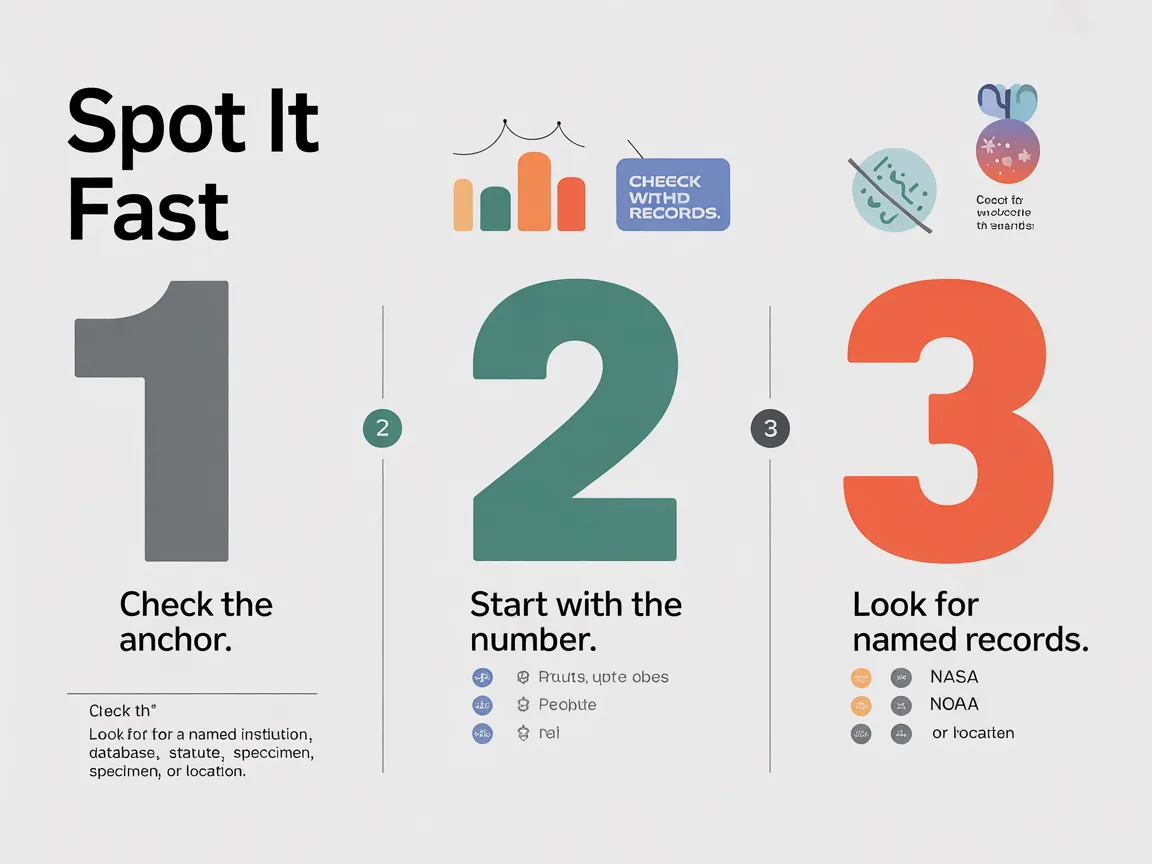
Here is a compact sample of how the framework works: Venus has a longer day than year scores high on Traceability, Specificity, and Stability because NASA documents the planet’s rotation and orbit; octopuses have three hearts scores high on Traceability and Stability through marine biology references; honey’s long shelf life scores high only if you add context, because the claim depends on storage conditions and what counts as “edible.”
- Check the anchor. Look for a named institution, database, statute, specimen, or location instead of a floating claim.
- Check the context. Ask whether the fact only holds in one place, one year, one classification system, or one narrow exception.
- Check the wording. Precise claims survive quotation; sloppy ones rely on surrounding sentences to make sense.
- Check the stability. If the fact depends on an active record, population count, or scientific classification, it may change.
- Check the repeatability. If you cannot imagine a person, instrument, archive, or specimen that could verify it, treat it as unconfirmed.
The fastest way to avoid viral trivia mistakes is to check whether a claim has a named anchor. Good facts usually point to a sourceable institution, a record, a law, a species, a date, or a place. Bad ones hide behind vague wording and impossible certainty.
A simple credibility filter for surprising facts
| Criterion | What to ask | What strong facts look like | Best used for |
|---|---|---|---|
| Source traceability | Can this be tied to a named source or institution? | NASA, NOAA, CDC, FDA, Library of Congress, Britannica, Smithsonian Magazine, National Geographic, Guinness World Records, or a clear primary record | Conversation, captions, classroom references |
| Specificity | Does the fact name a number, place, species, law, or measurable event? | Clear enough to check without guessing what it means | Quizzes, social posts, explainer content |
| Context dependence | Does it still make sense once you know the setting? | The claim includes its scope, limits, or exception | Sharing without overclaiming |
| Record stability | Is this a stable fact or one that can change? | A timeless property or a dated record that is labeled as such | Evergreen trivia, headlines, updates |
| Safe-to-repeat value | Could repeating it out loud make you look careless if it is wrong? | A fact with a clean trail and no hidden caveat | Party talk, school projects, newsletters |
Start with the number or the named source. If a claim uses a superlative, a record, or a precise count, ask who measured it and when. Guinness World Records, NASA, NOAA, the CDC, the FDA, the U.S. Census Bureau, the Library of Congress, Smithsonian Magazine, National Geographic, and Britannica can support claims when the topic fits their domain.
This filter works because most fake-looking facts fail in the same way: they are too perfect. Real trivia is usually messier, with a date attached, a range instead of a single number, or a note explaining why the claim is true in one context and misleading in another.
That’s also where trivia gets distorted when people share it: the Great Wall of China is often repeated as visible from space without explaining the conditions, and the old “jiffy” definition gets oversimplified instead of being framed as a technical term in computer science.
Why these facts go viral faster than ordinary trivia
Use carefully: some facts are true but easy to overstate. Honey can remain edible for a very long time under the right conditions, but “indefinitely” is a different claim; the Great Wall is enormous, but visibility depends on distance, atmosphere, and what “visible” means; a jiffy is a real unit of time in computing contexts, but that does not mean the everyday joke definition should be treated as universal.
Use the table as a quick sieve, not a courtroom. A fact does not need a footnote on every sentence to be real; it needs a clear path back to something checkable. The best trivia feels astonishing, but it never feels slippery.
One useful test is to ask whether the claim would still be true if you stripped out the dramatic wording. If the answer collapses, the fact is probably fluff. If the answer gets stronger when you simplify it, you have a keeper.
The bottom line for readers who want facts worth repeating
Surprising facts spread because the brain remembers violations of expectation. A fact like “Venus has a longer day than year” sticks because it flips an everyday mental model in one sentence. The shock is the hook, but the structure is what makes it memorable.
Short, concrete phrasing also travels well. “25 windows on the Statue of Liberty’s crown” is easier to share than a long explanation about monument design, and it gives people a tiny fact they can retell accurately. That is why the most durable trivia is usually compact, visual, and tied to a specific object or institution.
Frequently asked questions
What are some real did you know facts that sound fake?
The best facts to use in conversation are the ones that rank high on surprise and sourceability: Venus has a longer day than year, octopuses have three hearts, and honey can stay edible for a very long time when stored properly. They are easy to explain in one sentence, hard to dismiss, and specific enough to verify quickly.
How do I know if a weird fact is true?
Check whether the fact names a measurable detail, a real place, or a credible source such as NASA, NOAA, Britannica, or the U.S. Census Bureau. If the claim stays vague, changes wording depending on who repeats it, or lacks a traceable origin, treat it carefully. For each cluster of facts, the verification note is the same: keep the claim narrow, keep the source visible, and avoid adding a stronger conclusion than the evidence supports.
Why do some facts sound fake even when they’re true?
They sound fake because they break a common expectation, like how long a planet’s day lasts or how a biological trait works. Our brains often judge familiarity faster than accuracy, so unusual truth can feel suspicious at first. That is why the strongest entries in this list are the ones that keep the weird part, but also keep the measurement, the place, or the official source attached.
Can I use these facts for social media captions or quizzes?
Yes, and the safest way to share them is to keep the wording accurate and avoid exaggeration. If you want a fact for a caption, a quiz, or a conversation starter, choose one that is specific, sourceable, and resistant to misquote. For a practical rule: share facts that still make sense after you remove the hype, and skip anything that only works as a half-remembered viral line.